To place an AD send us an email (sosclassifiednews@gmail.com)or call us 559-551-8053
Articles & Reports
The Concha’s French Connection: Harmless Advertising or Cultural Erasure? By Sal Fonseca 10/5/2026
While Mexico's iconic sweet bread owes its soft dough to 19th-century French baking, corporate rebrands like Bon Appetit miss the historical point entirely.
Few pastries hold a more sacred spot in the pantheon of comfort food than the concha. As the undisputed monarch of Mexican pan dulce (sweet bread), this round, pillow-soft roll is instantly recognizable by the sweet, crumbly sugar crust scored to resemble a seashell. It is a staple of everyday Mexican life, usually torn apart and dipped lovingly into a hot mug of coffee or hot chocolate.
Yet, while the concha is a deeply rooted cultural symbol of Mexican identity, its DNA tells a fascinating story of European geopolitical conflict, migration, and high-society trends. To truly understand the concha, one must look past its Spanish name and examine its distinct French connection. But as corporate brands try to monetize this history, it begs an important question: Is it harmless advertising highlighting a historical connection, or a frustrating case of cultural reappropriation that gives Latino communities every right to be angry?
While Spanish conquistadors introduced wheat to Mesoamerica in the 16th century, the explosion of shapes that defines pan dulce arrived in the 19th century. Following geopolitical clashes like The Pastry War of 1838 and the French intervention of the 1860s, many French bakers settled in Mexico. The French culinary footprint deepened under the decades-long dictatorship of President Porfirio Díaz, a devout Francophile who sought to modernize Mexico by infusing its culture with French high society. Elite French bakeries opened in Mexico City, and local Mexican bakers quickly apprenticed under these European masters.
The architectural framework of the modern concha relies completely on two classic French components:
- The Base: The soft, airy, rich dough is heavily adapted from French brioche—an enriched, eggy, high-butter yeast dough that sits right on the boundary between bread and pastry.
- The Topping: The crumbly, melt-in-your-mouth topping is a direct sibling to French craquelin. In traditional French patisserie, a thin disc of butter, sugar, and flour is placed over pastry before baking, crystallizing into a uniform, sweet, crackled dome.
Where French baking prioritized uniform perfection, Mexican artisans saw a blank canvas for localized expression. They took the French brioche base, infused it with native vanilla or cinnamon, and blanketed it in a thick layer of sugar paste flavored with cocoa. By scoring lines into the paste with a knife, bakers ensured that as the dough baked and swelled, the sugar crust separated into the beautifully cracked replica of a seashell—or concha.
The concha successfully transformed a symbol of French colonial ambition into an independent staple of Mexican culture. However, this cross-cultural masterpiece faces a new kind of erasure in the modern supermarket.
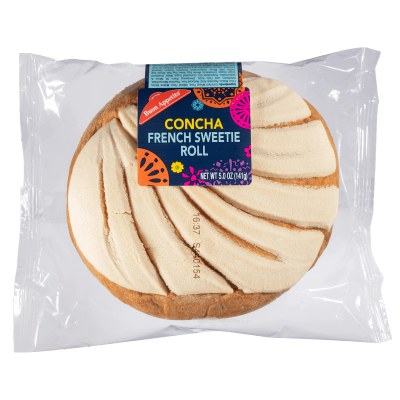
Walk down the pastry aisle of many American grocery stores, and you will encounter mass-marketed Bon Appetit Bakery products labeling the iconic Mexican bread as a "Concha French Sweetie Roll." While the historical ties to French technique are real, rebranding a Mexican cultural cornerstone with an abstract, Eurocentric moniker sparks deep criticism. Rather than properly educating consumers on the rich history of Mexican panaderos adapting French pastry, the packaging frames it as an "authentic taste of French pastries."
For many, this isn't just advertising that misses the point—it feels like cultural whitewashing. It treats the word concha as an exotic afterthought while using a European aesthetic to make the food feel more "premium" to a non-Latino audience, stripping Mexican bakers of the credit for a pastry they spent over a century perfecting.
Ultimately, the concha is a masterclass in culinary synthesis. It was inspired by France, born in Mexico, and perfected by generations of local bakers. No matter what slick corporate labels print on a plastic wrapper to drive sales, the soul of this seashell roll belongs entirely to Mexico.